Sunday, 19 August 2018

Ajanta Caves located at Ajanta, Aurangabad District, Maharashtra, India

'World Heritage Site Special'


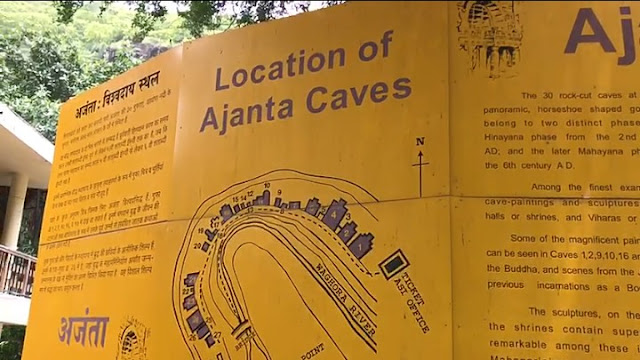
These are photographs of English commemoratives board, exterior and interior of thousands years old Ajanta Caves Monuments located at Ajanta, Aurangabad District , Maharashtra, India. 30 rock-cut Buddhist caves Monuments, dated back from 2nd century B. C. to 1st century A. D. And 5th century A. D to 6th century A. D. at Ajanta have been excavated in a panoramic, horseshoe shaped gorge of the Waghora River. This site is a proof of civilized civilization of ancient man of Sub-continent. Ancient Paintings and rock-cut sculptures of Ajanta Caves Monuments are Exemplary and well preserved by the authorities. These caves are masterpieces of Buddhist religious art. Ajanta Caves Monuments is a protected Monument and have been a UNESCO World Heritage Site since 1983.


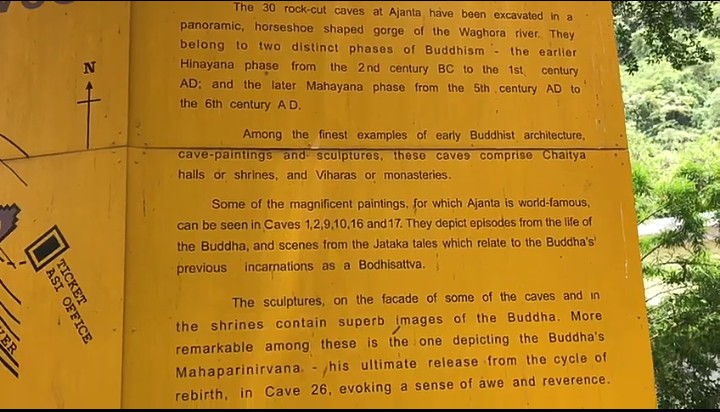
The History of Ajanta caves written on commemorative board Erected by World Heritage Site Organization describes as under:


'Ajanta'


'30 rock-cut caves at Ajanta have been excavated in a panoramic, horseshoe shaped gorge of the Waghora River. They belong to two distinct phases of Buddhism, the earlier Hinayana phase from the 2nd century B. C to 1st century A. D. And later Mahayana phase from the 5th century A. D to 6th century A. D.


Among the finest examples of Buddhist architecture, cave-paintings and Sculptures, these caves comprise  Chaitya halls or shrines, and Viharas or monasteries


Some of the magnificent paintings, for which Ajanta is World-famous can be seen in caves 1,2,9, 10,16 and 17. They depict episodes from the life of the Buddha and seen from the Jataka which relate to Buddha 's previous incoronation as Budhissattva.


The sculptures on the facade of  some of the caves and in the Shrines contain superb images of Buddha. More remarkable among these is the one Depicting the Buddha' s Mahaparinirvana, - his ultimate release from the cycle of rebirth. In cave 26, evoking a sense of awe and reverence.'


Photographs By Dr. Dalvir Pannu Sahib


Friday, 17 August 2018

Banyan tree at Ajanta, Maharashtra, India

'Planting a Tree 🎄 is a Great Virtue'


These are The Photographs Of Persian/English Commemorative Stone And Banyan tree planted in 1937 A. D by the Rt. Hon'ble Sir Akbar Hydari, Nawab Hydar Nawaz Jung Bahadur P. C., D. C. L. (OXON), President of H. E. H., The Nizam's Executive Council planted this tree for the comfort of Visitors and also to remind them of the enlightnment of the Budha under a Bodhi tree. This Banyan tree is located at ancient Ajanta caves Monuments, Maharashtra, India. This tree was planted remembering Lord Budha 's enlightnment under a Tree.


On my request, Famous Historian of India, Dr. Subhash Parihar Sahib Decipher the Persian and English writing including a Persian poem of commemoratives stone Erected with the tree in this way:


Hu al-Noor
Dar sana 1356 Hijri mutabik sana 1937 Isavi Aali Janab Nawab Sir Haider Nawaz-i Jung Baha-
dar P.C.D.C.L. (Oxon) Sadr-i Azam Daulat-i Asfiya in darkhat ra barai aasaish khalaq
..............Mahatma Gautam
Qita' taarikh

1. ba zere sayaa aan aar mi....... Khalaq  (hamesha?)
    darkhat-i ilm ki Hyder Nawaz Jung bakasht

2. Wazir-i Asif haftam, yagana-i Dauran
     ki dar kayamat o din parwari nazir nadasht

3.  ........ki ............aqal khair-andesh
     pai rafa' ......yaq daqiqa naguzarsht

4....... ........ ki barai..........................darust
    lawa'i.......... wa neku ra bulandtar afrasht

5. nashanid nakhl ki mahatma Gautam
    ba deed-i noor-i haqeeqat....................

6. rawan raushan ki ba khama-i mahvi
   darakht jalwa-i haqq, saal in amal bangasht

7. Muslim ast hayat abd pae aan kas
    ki kard kar-i naikui, wa naam naik guzasht

Translation:
He is Light.
In the year 1356 Hijri, that is, the year 1937, Janab Nawab Sir Haider Nawaz-i Jung Baha-
dar P.C.D.C.L. (Oxon) Prime Minister of the Daulat-i Asafiya, for the rest of the world, planted this tree..... the Sage Gautam.
Verses of Date
1.  The people of the world, always come under the shadow of this tree of knowledge that Hydar Nawaz Jung has planted.
2.  [Who is] the Wazir of Asaf VII, Unique of the Age; in.... and nourishing faith he has no equal.
3. ................that........far-sighted wisdom; ........... not one minute passes
4. ...............
5. Sat in this plantation the Greta Sage Gautam [Budha] ; to see the light of truth...
6. With the pen of comprehension, and flowing ink; this tree of .... Truth, the yea of this act declared
7. He is a Muslim... that accompolished a work of Goodness, and earned good name.
IN 1937 A.C. THE  RT HON'BLE SIR AKBAR HYDARI                                                                                       NAWAB HYDAR NAWAZ JUNG BAHADUR P.C.D.C.L. (OXON.)
PRESIDENT OF H.E.H. [His Exalted Highness]THE NIZAM'S EXECUTIVE COUNCIL
The words ' kard kar-i naikui, wa naam naik guzasht' in the last line form a chronogram also yielding the year 1356, also mentioned at the top.

Fortunately, I've succeeded in identifying Sir Haider Nawaz-i Jung Bahadar P.C.D.C.L. of the inscription. The details of his carrer are as follows:

Sir Akbar Hydari (born 8 November 1869 at Bombay), mentioned in this inscription from Ajanta Caves, Maharashtra, India, was the President of the Executive Council, and Prime Minister, from 18 March 1937 up to September 1941, at the court of Nizam VII of Hydarabad State (1911-1948). Belonging to the Sulaymani Bohra Muslim Community, he was the first Muslim to pass the examination of the Gazetted Officer for the Finance Department. He was the most competent and ablest Prime Minister of the State, and was Knighted by the British Government (on 17 December 1929, by Lord Irwin), and the Nizam gave him the title of Hydar Nawaz Jung. He founded the Osmania University (Hyderabad) and was largely responsible for the restoration of the Ajanta caves.
He 1941, he was appointed as the member of the Executive Council of the Viceroy of India. He represented Hyderabad State in three Round Table Conferences in London. He lies buried at the Bohr


Tuesday, 14 August 2018

Sas Bahu Temple situated at Gwalior, India

All These Photographs are related to Commemorative Stones and old times beautiful building of Sas Bahu Temple situated at Gwalior, India. The Construction of Sas Bahu Temple was Started by King Ratanapala and completed during the reign of Mahipala in 1093 A. D.


First commemorative stone reads as :


'This temple was cleaned and stripped of the Chuna with which Mahomedans has defaced it for centuries by Major J. B. Keith November A. D 1881 under the directions of Captain H. Cule. R. E. Curator of Ancient Monuments in India. '


Second commemoratives stone Describes As under:

'Sas Bahu Temple'

The group of two Temples standing on the eastern corner of the Gwalior Fort is popularly known as Sas Bahu Temple. The literal meaning denotes Mother - in-law and Daughter - in - law. Generally applied for the bigger and smaller temples respectively. The original name of the temple was derived probably from 'Sahastrabahu' meaning thousand arms. In due course of the time, it came to be known as 'Sas Bahu'. The Architectural grandeur of glorified the temple building traditions of the Kachchhapaghata rulers.

The Construction of the temple was Started by King Ratanapala and completed during the reign of Mahipala in 1093 A. D. Fully developed temple plan is aligned in the north-south direction. Having Garbha-Griha Antarala, Mahamandapa and Ardhamandapa from South to North. The exuberantly carved pillars and Ceiling of the central hall are flanked by porches on three sides. The exterior walls are richly carved with floral, geometric designs, elephant figures, musicians and scenes from Krishna Lila. The exterior decoration of the smaller temple is also similar. It possesses a vestibule and a small central hall.

The stone Inscription fixed on the portico of the bigger temple refers about its construction, religious congregation, folk rituals and revenue allotted for the temple. '


Photographs By Dr. Dalvir Pannu Sahib