Showing posts with label CAVE. Show all posts

Sunday, 19 August 2018

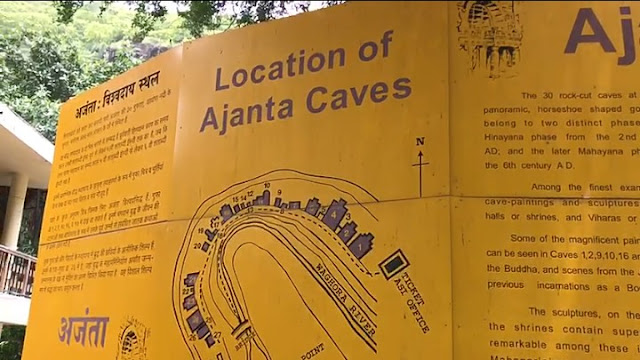
Ajanta Caves located at Ajanta, Aurangabad District, Maharashtra, India

'World Heritage Site Special'


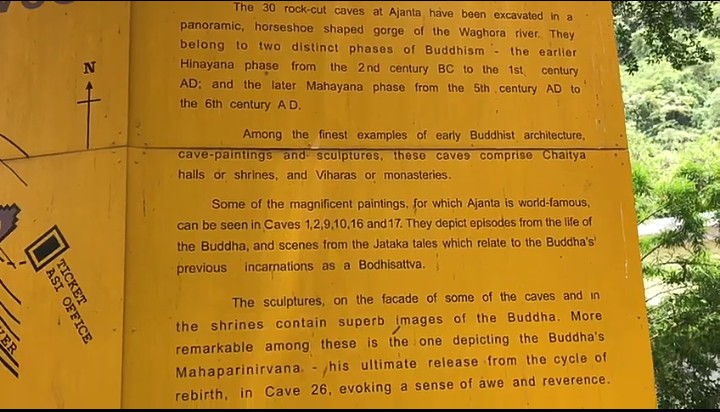
These are photographs of English commemoratives board, exterior and interior of thousands years old Ajanta Caves Monuments located at Ajanta, Aurangabad District , Maharashtra, India. 30 rock-cut Buddhist caves Monuments, dated back from 2nd century B. C. to 1st century A. D. And 5th century A. D to 6th century A. D. at Ajanta have been excavated in a panoramic, horseshoe shaped gorge of the Waghora River. This site is a proof of civilized civilization of ancient man of Sub-continent. Ancient Paintings and rock-cut sculptures of Ajanta Caves Monuments are Exemplary and well preserved by the authorities. These caves are masterpieces of Buddhist religious art. Ajanta Caves Monuments is a protected Monument and have been a UNESCO World Heritage Site since 1983.


The History of Ajanta caves written on commemorative board Erected by World Heritage Site Organization describes as under:


'Ajanta'


'30 rock-cut caves at Ajanta have been excavated in a panoramic, horseshoe shaped gorge of the Waghora River. They belong to two distinct phases of Buddhism, the earlier Hinayana phase from the 2nd century B. C to 1st century A. D. And later Mahayana phase from the 5th century A. D to 6th century A. D.


Among the finest examples of Buddhist architecture, cave-paintings and Sculptures, these caves comprise  Chaitya halls or shrines, and Viharas or monasteries


Some of the magnificent paintings, for which Ajanta is World-famous can be seen in caves 1,2,9, 10,16 and 17. They depict episodes from the life of the Buddha and seen from the Jataka which relate to Buddha 's previous incoronation as Budhissattva.


The sculptures on the facade of  some of the caves and in the Shrines contain superb images of Buddha. More remarkable among these is the one Depicting the Buddha' s Mahaparinirvana, - his ultimate release from the cycle of rebirth. In cave 26, evoking a sense of awe and reverence.'


Photographs By Dr. Dalvir Pannu Sahib


Thursday, 6 April 2017

Naturally Formed Borra Caves Located in District Visakhapatnam, Andhra Pradesh ,India.


' Geographic Special '


These Are some pictures of commemorative board and Millions of years old Naturally Formed Borra Caves Located in District Visakhapatnam, Andhra Pradesh ,India. William King the British geologist discovered in 1807 naturally fromed & believed to be 150 million years Old.


The Borra Caves are located on the East Coast of India, in the Ananthagiri hills of the Araku Valley The caves, one of the largest in India, at an elevation of about 705 m (2,313 ft). The caves are basically karstic limestone structures extending to a depth of 80 m (260 ft), and are considered the deepest caves in India.

It is written on English Commemorative board of Borra Caves,
'Borra Caves
William King the British geologist discovered on the 1807 naturally fromed & believed to be 150 million years Old.
Borra Caves Are located about 90 kms North of Visakhapatnam in The Ananthagiri hill ranges of eastern that's, which range between 800 to 1300 mtsM.S.L in The Andhra Pradesh. William King, the British geologist discovered the Caves in 1807. Borra (Hole in Oriya) caves Are naturally fromed and believed to be 150 million years Old. The humic acid in The water reacts with The calcium carbonate in The limestone and dissolved the minerals breaking the rock gradually. The perennial water flow over a period of time results in The formation of caves. Small streams from hillock going towards Gosthani river (Gov-Cow, Sthani-Udder) carved out the caves. The water percolating from The roof containing calcium bi carbonate and other minerals from The mounds on The ground called"Stalagmites" and spear like structure hanging from The roof called "Stalactites". The Stalactites and Stalagmites acquire different shapes inspiring the imagination of The tourists and locals and earing in eresting names and characters like Shiv-Parvathi, Mother-Child, Rushis-Beard, Human brain, crocodile, Tiger , Cows Udder etc.  The formation of brain-shaped stalagmites at central point of Borra Caves can be said as the gift nature

The main entrance of Borra caves is at an altitude of 705 meters MLS while The interior goes down 625 meters MLS. The total length of Borra caves is about 200 meters, but the distance you trek in The caves is about 350 meters. The DBK (Dandakaranya-Bolangir, Kibur) train track is laid over The caves. The Gosthani river that takes care of The thirstiness of The vizagities takes birth at Borra caves areas. Breath taking hilly terrain, beautiful land scape, Semi-evergreen moist deciduous forest and wild fauna of The area are a visual feast. The hill track are inhabited by The tribals, Jatapu, Porja, Kondadora, Nookadora,valmiki etc.
Anthropologists of Andhra Pradesh University, who conducted excavations in The cave , found Stone tools of middle Paleolithic culture, dating back to 30,000 to 50,000 years, indicating human habitation. There is natural Siva Linga deep inside The caves and thousands tribals visit the caves during Siva Ratri festival every year. This Cave  isone of its kind in India and is a pleasure for every tourist coming to Visakhapatnam to visit the caves.'

Pictures Gifted by Inderjeet Singh ji.

Monday, 9 January 2017

ELEPHANTA CAVES

These Are Some Pictures Of Commemorative Board/Stone, Maps, Elephant Sculpture And Hundreds Of Years Old Network Of Elephanta Caves Located At Elephanta Island Near Mumbai, Maharashtra, India. The Elephanta Island Is located In The Arabian Sea. Elephanta Caves Consists Of Two Groups Of Caves; The First Is A Large Group Of Five Hindu Caves And The Second Is Smaller Group Of Two Buddhist Caves. The Hindu Caves Contain Rock Cut Stone Sculptures, Representing The Shaiva Hindu Sect, Dedicated To The Lord Shiva.This Rock Cut Architecture Of The Caves Has Been Dated Back Between The 5Th And The 8th Centuries A.D. The Identity Of The Original Builders Is Still A Subject Of Debate.The Ancient Elephant Sculpture From The Elephanta Island Is Transferred And Installed At The Victoria Garden Mombai Now.
It Is Written On One Of The Commemorative Board Erected Near Elephanta Caves By The Archaeological Survey Of India Mumbai Circle:

ELEPHANTA CAVES

' The Island Of Elephanta, Originally Known As Gharapuri, Derived Its Name From A Massive Stone Image Of Elephant Now Displayed In The"Veermata Jijabai Bhosale Garden" Victoria Garden In Mumbai. The Cave Complex Of Elephanta Comprises Total 7 Caves Of Then Five Are In Lower Western Side, While Two Are At The Eastern Top Of Hillock. Out Of Five Caves At The Lower Side The Cave No. 1 Is Exclusively Curved With Various Manifestation Of Lord Shiva. It Consists Of A Pillared Hall With A Small Shrine And Four Entrance Doors Flanked By The Guardians. While The Massive But Graceful Figures Of Divinities, Guardians And And Certain Architectural Figures Such As The Square Pillar With Cushion Capital Suggest Chalukyan Influence. The Depiction Of Mountains And Clouds And The Hairstyles Of Women Are Reminiscent Of Gupta Art.
Facing North The Main Cave Consists Of A Sanctum And Massive Hall Divided Into Five Bays. The Excellent Carved Panels On The Walls Of This Cave Include The Yogeshvara (Lord Of Yoga), Nataraja Shiva (Cosmic Dancer), Shivaparvati, Ardhanarishvara, Gangadhara, Andhakasuravadha, Ravananugraha Shiva,Kalyansunder Morti And Maheshmorti. The Ceiling Of The Main Cave Is Believed To Have Been Originally Painted With Different Colours. The Maheshmorti Of Shiva Is Depicted On The South Wall With Three Aspects Of Creation, Protection And Destruction Revealing A Masterpiece Of Chalukyan Gupta Art.
The Circular Pedestal In The Open Courtyard Marks The Seat Of Nandi (Bull) The Vehicle Of Shiva. The Side Cave Has A Small Shrine And A Pradakshinapatha ( Eight Mother Goddesses) Flanked By Kartikeya And Ganesha.
The Other Caves Are Plain And Lesser Embellished. The Other Antiquarian Remains Found In Elephanta Caves Are Stupa (3rd Century B.C) At The Top Of Hillock , Kshatrapa Coins Of The 4Th Century And Some Sculptures Including Mahishasurmardini, Four Headed Image, Brahma, Vishnu And Garuda.
This Site Was Declared By The Archaeological Survey Of India As A Monument Of National Vides No. 2704-A Dated 26-5-1909 And Thereafter Inscribed By The UNESCO As A World Heritage Site In the 1987.'
Source: Internet Search