Saturday, 11 March 2017

The tomb of Sher Shah Suri

Lodhi Dynasty (Tomb of Emperor Sher Shah Suri):
The tomb of Sher Shah Suri is in the Sasaram town of Bihar state, India. The tomb was built in memory of Emperor Sher Shah Suri, a Pashtun who defeated the Mughal Empire and founded the Suri Empire in northern India. He died in an accidental gunpowder explosion in the fort of Kalinjar on 10th day of Rabi' al-awwal , A.H. 952 or 13 May 1545 AD.
Architecture:
His tomb is an example of Indo-Islamic architecture, it was designed by the architect Aliwal Khan and built between 1540 and 1545, this red sandstone mausoleum (122 ft high), which stands in the middle of an artificial lake, which is nearly square, is known as the second Taj Mahal of India. The tomb stands at the centre of the lake on a square stone plinth with domed kiosks, chhatris at each of its corners, further there are stone banks and stepped moorings on all sides of the plinth, which is connected to the mainland through a wide stone bridge. The main tomb is built on octagonal plan, topped by a dome, 22-metre in span and surrounded ornamental domed kiosks which were once covered in coloured glazed tile work.
The tomb was built during the reign of his son Islam Shah Suri. An inscription dates its completion to August 16, 1545, three months after the death of Sher Shah Suri.


Sher Shah Suri Masjid, mosque, Patna

Lodhi Dynasty (Sher Shah Suri Masjid):
Sher Shah Suri Masjid, mosque, Patna ,also known as Shershahi, is an example of the Afghan style of architecture. Sher Shah Suri built this mosque in 1540–1545 to commemorate his reign. It is sited in the south-west corner of Purab Darwaza near Dhawalpura.
Architecture:
Built in Afghan architectural style, it is one of the many historic mosques in India and a landmark in Patna. There is a tomb inside the complex of the mosque which is covered by an octagonal stone slab. But the star attraction of the Sher Shah Suri Masjid is its central dome which lies in the middle of the roof and is surrounded by Four small domes. The unique part of thist design is that if you view from any angle there appears to be only three domes.


Cannon Located at Village Dulmial, Chakwal, Punjab, Pakistan.


These Are Some Pictures of English Commemorative Stone And The Cannon Awarded By The British In Recognition of War Services During World War I Located at Village Dulmial, Chakwal, Punjab, Pakistan.
Dulmial Village of Salt Range Sent 460 Men to Fight in British Indian Army in The World War I of Which 9 Soldiers Were Martyred. It is The Largest Single Participation of Any Village in South Asia. This Cannon Was Made at Carron Ironworks Cossipore Scotland in 1816 A.D. Its Stand was Built in Cossipore Gun Foundry India Under The Leadership of Captain A. Broome in 1847 A.D. Dulmial is now Known as 'The Village With The Gun'.

It is written on The Commemorative Stone Erected With The Gun at Village Dulmial.

' This Gun Was Awarded to Dulmial In Recognition of Services Rendered by All Ranks From This Village During And Prior to First Great War 1914-1919.
The Gun Was Brought From Jhelum And Placed Here Under The Supervision of Honorary Captain Malik Ghulam Muhammad And Other Veterans in 1925.'

Reference: Article ' Historic Scottish Cannon In Pakistan' By Dr. Irfan Malik Ji
Pictures By Dr. Irfan Malik Ji


Thursday, 9 March 2017

Holy Trinity Cathedral Church Located at Sialkot, Punjab, Pakistan


These Are Some Pictures of Commemorative Stone And British Times Beautiful Building Of Holy Trinity Cathedral Church Located at Sialkot, Punjab, Pakistan.
It is Written on The Commemorative Stone of The Church:
' The Church Was Designed And Built By Lt. J. Hartley Maxwell Bengal Engineers.
The Foundation Stone Was Laid on 1st March 1852. The Church Consecrated On 30th Jan 1857. 51 Monumentum Requiris Circumspice.'

Pictures By Falak Sher Bajwa Ji

Tuesday, 7 March 2017

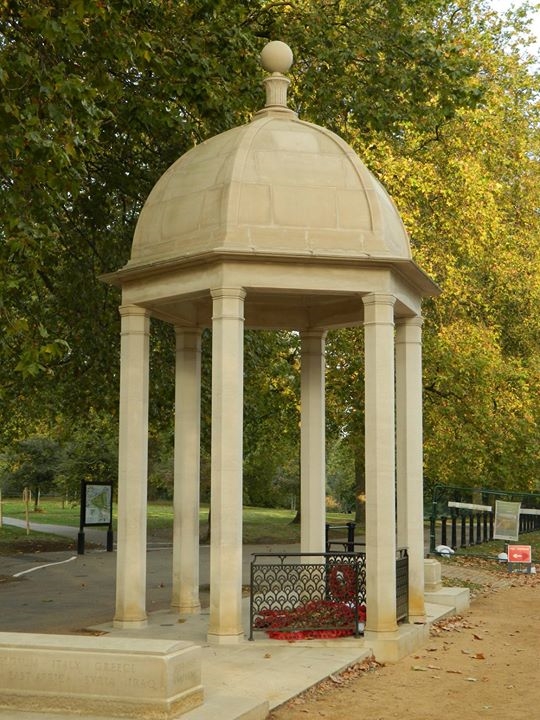
Memorial Gate And Pavilion Located at Constitution Hill Near Buckingham Palace London, United Kingdom.

' Very Special Post '

These Are Some Pictures Of Commemorative Stones, Memorial Gate And Pavilion Built in The Memory of Five Million Soliders From India, Pakistan, Bangladesh, Nepal, Africa And Caribbean Who Took Active Part In The World War I & The World War II Located at Constitution Hill Near Buckingham Palace London, United Kingdom. The Memorial Gate And Pavilion Was Unveiled in 2002. There Erected Six Commemorative Stones Having The Names of Recipients Of Victoria Cross And George Cross On The Interior Ceiling of The Pavilion. Without the Active Participation of These Five Million Brave Soldiers From Different Countries, The Great Britain Could Never be Able to Win World War I &II. The Number of Indian Soldiers Was Large Than Any Other Allied Country.  There were 12 George Cross Recipients And 62 Victoria Cross Recipients From These Countries. Their Names are written on Interior Commemorative Stones of The Pavilion Separately as well.
It is Written on Commemorative Stone Erected Near Memorial Gate And Pavilion London, England:

' A Debt of Honour '
'The Memorial Gate '

' This Memorial was inaugurated by Her Majesty The Queen during The Golden Jubilee year,2002. It Commemorates the Services and sacrifices of five million Men and women from The Indian Sub-Continent, Africa and The Caribbean, who volunteered to fight with The British in Two World Wars ,1914-18 and 1939-45.

This is The first time that their magnificent contribution has received fitting recognition.
With so many descendants of these Volunteers now living in The United Kingdom, The Memorial Gates serve to remind us all of our shared sacrifices in The time of Greatest need.

First World War, 1914-18
Indian Sub-Continent and Kingdom of Nepal 1,440,500 Men and women, including 100,000 Gurkhas, volunteered for Military service in Indian Army. They fought on The Western front, in Gallipoli, Persia, Egypt, Palestine and Mesopotamia.

Africa:
The Old British African Colonies provided 62,000 troops and the transport auxiliaries who fought in Africa.
Caribbean:
Over 15,000 men served in The British West Indies Regiment and saw action in France, Palestine, Egypt and Italy.

Second World War, 1939-45:
Indian Sub-Continents and The Kingdom of Nepal over 2,500,000, including 132,000 Gurkhas, served in Burma, Malaya, Hong Kong, North and East Africa, France, Italy, Greece and throughout the Middle East.

Africa:
Over 372,000 mostly from East and West Africa, served in The Middle East, East Africa, Italy and Burma.

Caribbean:
Over 7000 Men and women volunteered to aid the war effort, many of whom saw action in The Middle East, Far East, East Africa and Italy.

The Memorial Gates have been funded by a National Lottery Grant from The Millennium Commission and The generous support of Trusts, Foundations and The members of Public.
This panel was donated by The Friends of War Memorials and West Indies Ex-Service Association U.K.'
Second Stone reads as:
' In The memory of five million volunteers from Indian Sub-Continent,Africa and The Caribbean who fought with Britain in The Two World Wars.'

The names of Recipients of Victoria Cross and George Cross are written on The commemorative Stones erected on The interior ceiling of The Memorial Pavilion.
First Interior Stone Reads as:
George Cross Recipients 1939-45:
' Pir Khan, S. Latutin, Kirpa Ram, Ditto Ram, St. J. G Young, H. P Seagrim, Islam-Ud-Din, Subra Manian, Abdul Rahman, Matreen Ahmad Ansari, Mahmood Khan Durrani, Noor-Un-Nisa Inayat Khan.' (12 Soldiers)
Second Interior Stone Reads as:
Victoria Cross 1939-45
' Fazal Din, F. G Blaker, Gian Singh, Kamal Ram, C. Raymond, Gangu Lama, Umrao Singh, J. D. Nettleton, Q. G. M Smythe, Tulbahadur Pun, Lalabahadur Thapa, Lachhiman Gurung, Karamjeet Singh Judge.' (13 Soldiers)
Third Interior Stone Reads as:

Victoria Cross 1939-45

' Ali Haidar, G. R. Norton, Band Singh, Chhelu Ram, E.C.T Wilson, Richpal Ram, A. E. Cumming, Namdeo Jadhao, Ram Sarup Singh, Parkash Singh L. Hav, Bhanbhagta Gurung, Netrabahadur Thapa, Premindra Singh Bhagat. ' (13 Soldiers)

Fourth Interior Stone Reads as:

Victoria Cross 1939-45
' E. Swales, Sher Shah, N. G. Leakey, Gaje Ghale, M. Allmand, Abdul Hafiz, Agansing Rai,Bhandari Ram, Thaman Gurung,Parkash Singh Jem, Yeshwant Ghadge, Sherbahadur Thapa, Sefanaia Sukanaivalu.' (13 Soldiers)

Fifth Interior Stone Reads as:

Victoria Cross 1914-18
'Mir Dast, E. Jotham, F. C. Booth, W. F. Faulds, Badly Singh, G. C. Wheeler, Chatta Singh, Gobind Singh W.A Bloomfield Shamshad Khan, Darwan Singh Negi.'  (11 Soldiers)
Sixth Interior Stone Reads as:
Victoria Cross 1914-18
' Lala, J. G Smyth, J. A Sinton, F. A. De Pass, J. F. P. Butler, W. H. Hewitt, Kulpir Thapa, W. A. Mc G. Bruce, G. G. M. Wheeler, Khudadad Khan, Gobar Sing Negi, Karanbahadur Rana.' (12 Soldiers)

The countries who favoured Great Britain in The World Wars I & II are named as 'Allied Force'.  The names of The countries who favoured Great Britain in The World Wars are also written on The Premises of this Memorial in this way.

1914-1918 Campaigns
' West Africa, Egypt, East Africa,France, Belgium, Gallipoli, Russia, Mesopotamia, Persia, China, Syria, Palestine, Arabia '

1939-1945 Campaigns
' France, Belgium, Italy, Greece, North Africa, East Africa, Syria, Iraq, India, Burma, Malaya, Singapore, Persia, Hong Kong, Dutch East Indies '

Photography By Irfan Malik Ji


Sunday, 5 March 2017

Battle of Delhi 1803 Monument Located At Patparganj, Delhi, India.

All these photographs Are of English And Urdu Commemorative Stones Of Battle of Delhi 1803 Monument Located At Patparganj, Delhi, India. This Battle was fought between The Marathas And The British Army. Same Inscriptions Are Written Both in English and Urdu Commemorative stones of The Monument. It is written in English  On Commemorative Stone.
' Near This Spot Was Fought On Sept 11th 1803 The Battle of Dehli In Which The Forces of Mahrattas  Commanded by M. Louis Bourquien Were Defeated By British Army Under General Gerard Lake.'

We Are presenting an article Written by Gurpreet Singh Anand Ji about Battle of Dehli.

By Gurpreet Singh Anand
The Marathas were the real rulers of Delhi in the beginning of the 19th century and Shah Alam -II just a nominal head .
The British ever eager to expand their empire north were at war with the Marathas in what is called Second Anglo-Maratha War . Near Delhi at Patparganj a battle took place on 11th September 1803 .The British led their attack with about 5,000 men under General Gerard Lake .In opposition to little over 15,000 men of Maratha forces led by the French General Louis Bourquin.The latter commanded 18 battalions belonging to the 2nd and 3rd brigades which were previously in command of his friend General Perron .His bosom friend had commanded the poor old Shah Alam to invest him with the supreme authority .Shah Alam “deputed more authority from prison than many a sovereign have done from throne “ , but his keeper , Captain Drugeon , stood by Perron and had to be forced into submission by Bourquin .
Meanwhile Perron had been defeated and surrendered to the British giving air to Bourquin’s assertions that his erstwhile friend was a traitor .It was the remnants of Perron at Shikohabad and Aligarh who flocked to him and became part of his 15,000 strong force .Lake then marched against him from Aligarh .
Holkar’s forces were well entrenched with Yamuna River at their rear and swamp on either side that led the British , Thorn , to comment that only a frontal attack was possible . Then followed Lake’s famous ruse .Lake manoeuvred to feign a retreat of his cavalry on which the Maratha forces left their well entrenched positions in attacking forces retreat and Lake’s ploy succeeded .He bayoneted his opponents in thousands and threw them into the Yamuna River .The loss of British is only recorded at around 500 men to around 3000 of the forces under the French General .The defeat became a rout .
The fighting ensued for three days and Delhi was up for taking by the British who became its de facto rulers after this battle sometimes called Battle of Patparganj and at other time as Battle of Delhi .A memorial was erected at this spot that exists to this day .
So searching along with my brother Col PPS Anand we went in search of the memorial and found it in a corner of the Golf Club in Noida with few steps leading to the monument and inscribed on a stone in Urdu and in English about the battle of Delhi
The following extract from the order of the Government of India refers to this action in which they fell .” The Governor General in council sincerely laments the loss of Major Middleton , Captain McGregor , Lieut . Hill , Lieut .Preston , Cornet Sanguine , Quarter Master Richardson and of the brave soldiers who fell in the exemplary exertions of deliberated valour and discipline spirit at Battle of Delhi . The names of these men will be communicated with the glorious events of the day on which they fell ,a nd will be honoured and revered while the flame of that signal victory shall endure .”
This monument was repaired and the tablet which had disappeared was replaced by the order of Lieutenant of the North West Frontier Province in 1808 .
The reason to post this on this group is that Yashwant Rao Holkar after his defeat reached Amritsar after crossing the Sutlej in 1804.He reached Amritsar where Maharajah Ranjit Singh met him even while he visited Harmandir Sahib to pay his obesience .He sought Ranjit Singh’s assistance , as he had also written to other rulers in India , in making a united stand against the East India Company .
Meanwhile Lake along with Malwai Sardars came to stay at the bank of river Beas and sent Raja Bhag Singh to persuade his nephew, Maharaja Ranjit Singh, not to espouse the hopeless Maratha cause. In Umdat Ut-tawarikh Daftar II , Sohan Lal Suri , on page 49 states “ Raja Bhag Singh told him in secrecy that it was against good reason to oppose the English .He should therefore , abstain from joining hands with Holkar and conclude an alliance with the English .According to the advice of of the said raja , the Sarkar withheld the hand of friendship from Holkar ....One day the Sarkar went to the dera of Holkar . He offered variety of presents .On the following day Holkar came to the Sarkar .The exalted Sarkar, too , gave him many kind of presents .Then Holkar visited the Durbar Sahib ( The Golden Temple ) in the company of of the exalted Sarkar .Many a time they became closetted and discussed a number of matters .He often showed the Sarkar the parade of the platoons and impressed upon him the care of the platoons and regular army .He also emphasised the collection of the treasury .”
But Bhag Singh’s advice prevailed upon Maharajah Ranjit Singh and a golden opportunity was lost to throw firanghis from Indian soil .Suri further writes page 50 “ When Holkar learnt of the friendship between the English and the Maharajah he said that from the boundaries of the Daccan to the outskirts of the Punjab he had searched from courage and valour to join him in his battles and designs .But the more he searched he found that it was elusive .There was nothing in the world except man , but the real one was wanting .He felt for the time being none existed on the earth or under the sky .”
The Holkar Raja left by way of Kasur crossing river Beas and Sutlej and so also the English forces withdrew in its wake .Very interestingly Suri mentions further “ In the year 1862 Bikrami ( 1805 A.D. ) , when Holkar was at Jaipur and the General at Cawnpore , it is reported by the Sarkar that he had cast the letters purporting to the support of the Holkar and the friendship of the English in the presences of the ‘Granth’ ( The Holy Book of the Sikhs ) .He got the letter relating to the English in the lot .Accordingly he abstained from helping Holkar.”
Bhag Singh`s mediation in behalf of the British helped pave the way for the first Anglo Sikh Treaty of 1806. He gained in territory both from the British and Maharaja Ranjit Singh. Ludhiana, later acquired by the British for establishing a political agency, once belonged to him.

Pictures By Gurpreet Singh Anand Ji


Monday, 27 February 2017

Nilgiri Mountain Railway Tamil Nadu, India.

' World Heritage Site Special '


These Are Some Pictures of Commemorative Metal Plate And The Nilgiri Mountain Railway Built by The British in 1908 A.D Located at Tamil Nadu, India. In July 2005, UNESCO Added The Nilgiri Mountain Railway As an Extension to The World Heritage Site of Darjeeling Himalayan Railway. The Site Then Became Known as Mountain Railways of India. Mountain Railways of India
Include Darjeeling Himalayan Railway (West Bengal), Nilgiri Mountain Railway (Tamil Nadu) And The Kalka Shimla Railway (Himachal Pradesh). Mountain Railways of India Are an Outstanding Example of Excellent and Prodigal Engineering Skills Used to Combat The Problem
Establishing a Rail Link in The Hilly Area.


The Toy Train at Nilgiri Mountain Railway Links The City of  Mettupalayan With The Renowned Hill Station at Ooty in Tamil Nadu. The Nilgiri Mountain Railway Covers a Distance of 46 Kilometers Travelling all The way through 208 Curves, 16 Tunnels And 250 Bridges. Making it the slowest train of India, The train runs at The average speed of 10.4 Kilometers Per Hour for safety reasons.

It is written on the Commemorative Metal Plate of Nilgiri Mountain Railway Erected by UNESCO.:

' UNESCO, in 2005, has inscribed the Nilgiri Mountain Railway as a World Heritage Site, as Part of "Mountain Railways of India" Since:-

*- They Are outstanding examples of The interchange of values on development of a multicultural region, which was to serve as a model for similar developments in many parts of The world.
*- The development of railways in The 19th century had a profound influence on social and economic Developments in many parts of The world. They Are outstanding examples of a Technological ensemble, representing different phases of development in high mountain area.
This Confirms its Exceptional and Universal value which requires Protection for The Benefit of all Humanity.'


Pictures Gifted By Inderjeet Singh Ji


Saturday, 25 February 2017

Old House at Sargodha


All these pictures are of an Old beautiful building


Named Naranjan Niwas Having Some Gurmukhi commemorative writing on it located at Sargodha, Punjab, Pakistan. sardar  jai singh sardar tej singh


Pictures by Wasif Ali ji